
The United States has participated in 12 major wars and numerous smaller conflicts since gaining independence from Great Britain. Most of these were fought against other nations, though internal clashes involved conflicts between Americans and Native Americans, as well as the Civil War between the Northern and Southern states. Many residents of Queens have always stepped up to defend the country. Their heroism, loyalty, and bravery are honored by countless memorials. Here is a selection of the most famous monuments located in the borough, available on queensyes.com.
Queens Vietnam Veterans Memorial
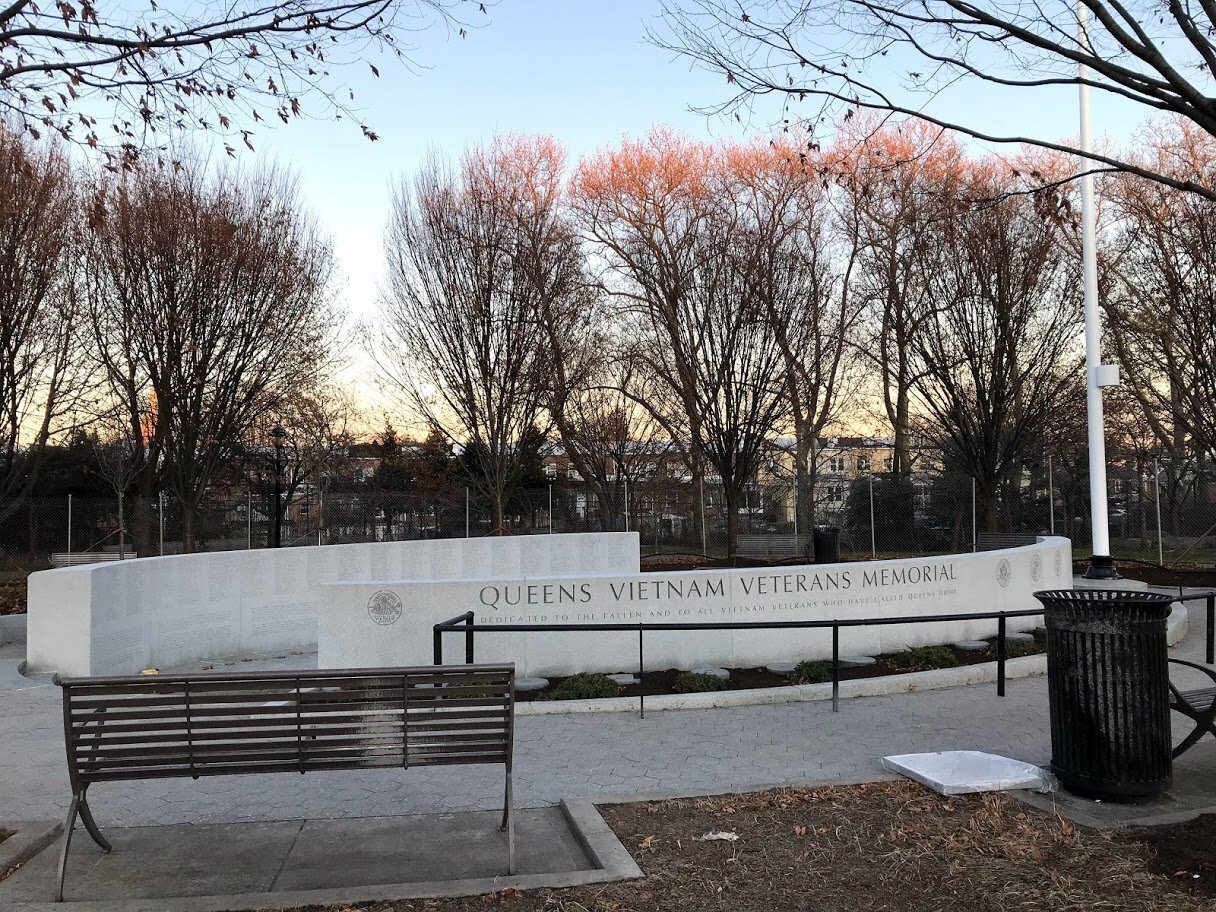
At the height of the Vietnam War, more than half a million American soldiers and officers were deployed to Vietnam. Over 58,000 U.S. citizens were killed or went missing during the fighting, including 371 service members from Queens. The Queens Vietnam Veterans Memorial in Elmhurst Park pays tribute to their sacrifice.
The Vietnam War, one of the longest armed conflicts in U.S. history, lasted from 1955 to 1975. Its roots date back to the 1940s, originating as a conflict between communists and French colonists. In 1954, after the French lost control of their colony, the Geneva Accords divided Vietnam into the communist North, led by Ho Chi Minh, and the pro-American South.
In 1955, to prevent communist expansion, the U.S. persuaded South Vietnam not to uphold the terms of the Accords. This sparked a military confrontation between the northern and southern parts of Vietnam. The North was supported by the USSR and China, while the South was backed by the U.S., Australia, New Zealand, and South Korea, among others. The U.S. fought in distant Asia with the aim of preventing the spread of communist ideology in Vietnam and, subsequently, other nations. However, despite the developed economy and mighty armed forces of the U.S., North Vietnam ultimately prevailed.
The Queens Vietnam Veterans Memorial was unveiled in 2019. The sunken elliptical space is framed by two gray granite walls. Carved into one of them are the names of the 371 Queens residents who were either killed or went missing. It is the first memorial in the borough dedicated to all its residents who participated in the Vietnam War. The monument’s installation was initiated by Melinda Katz, the Borough President at the time. Visitors will find a chronology of the war with brief descriptions of key events, a bamboo motif, a dedication to all veterans, the Vietnam Service Medal, and various military insignia. The center of the memorial features a granite map of the territory surrounding Vietnam.
Interestingly, in 2021, the monument was vandalized with graffiti. The perpetrators left violent messages referring to God, “fallen souls,” and “child killers.” Additionally, a swastika was placed above the number 110, an apparent reference to the 110th NYPD Precinct, which is based in northern Queens and covers the Corona and Elmhurst communities.
Astoria Park War Memorial
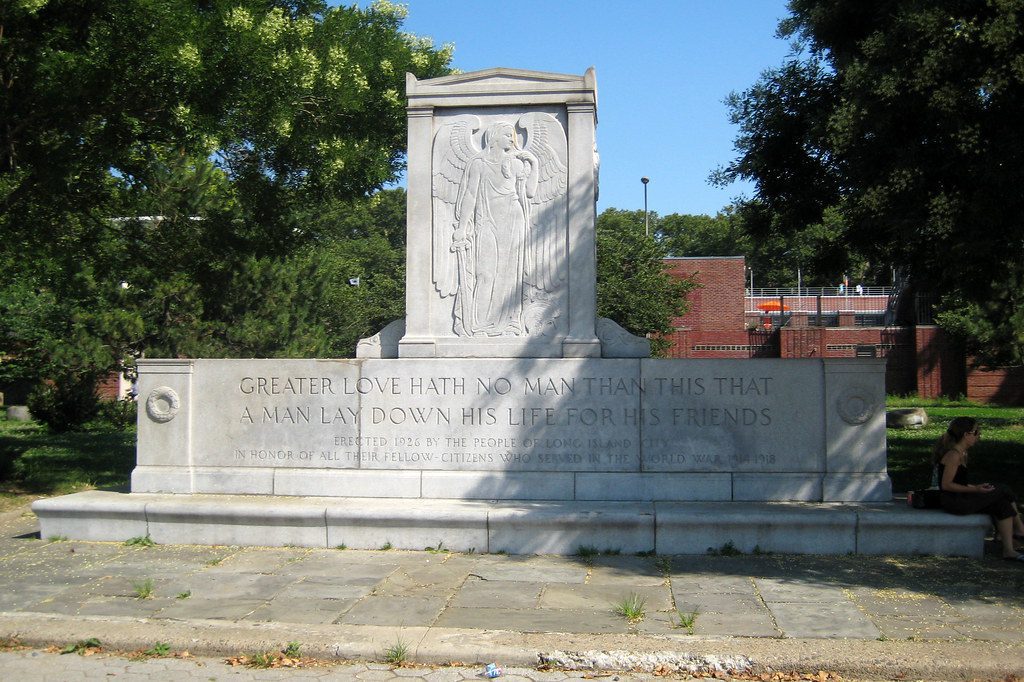
World War I, one of the bloodiest conflicts in human history, claimed the lives of over 116,000 American service members. In honor of the heroes from the Long Island City area, a monument was dedicated in Astoria Park in 1926. The Astoria Park War Memorial is a wide pedestal with a decorated stone stele, dedicated to the 101 fallen.
World War I lasted from July 28, 1914, to November 11, 1918. The immediate cause was the assassination of the Austro-Hungarian heir, Archduke Franz Ferdinand, by the Bosnian Serb nationalist Gavrilo Princip. Austria-Hungary subsequently declared war on Serbia, accusing it of involvement in the assassination. Two opposing blocs participated: the Allied Powers (led by France and Great Britain) and the Central Powers (led by Austria-Hungary and Germany). A total of 38 nations were involved in the conflict, which concluded with Germany’s capitulation.
The U.S. maintained neutrality until April 1917, when Germany announced unrestricted submarine attacks on vessels. Americans made a massive contribution to the victory of the Allied Powers. New York made the largest sacrifice of any state, losing 13,956 troops.
The Astoria Park War Memorial has a granite base. The decorative stele features a female figure holding a sword in her right hand and a laurel in her left, symbolizing war and peace, respectively. Sculpted wreaths adorn the sides of the stele. The engraved biblical quote from John 15:13 serves as a powerful reminder of the soldiers’ sacrifice:
“Greater love hath no man than this, that a man lay down his life for his friends.”
Richmond Hill War Memorial
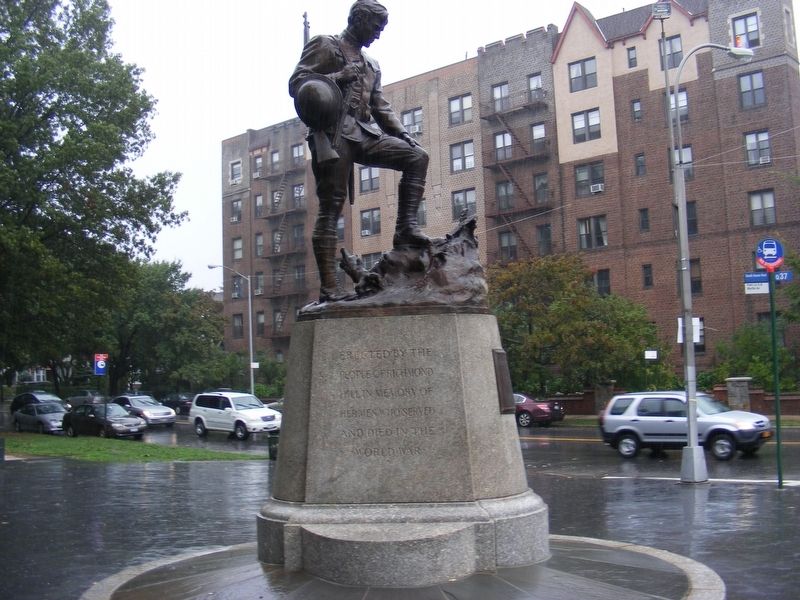
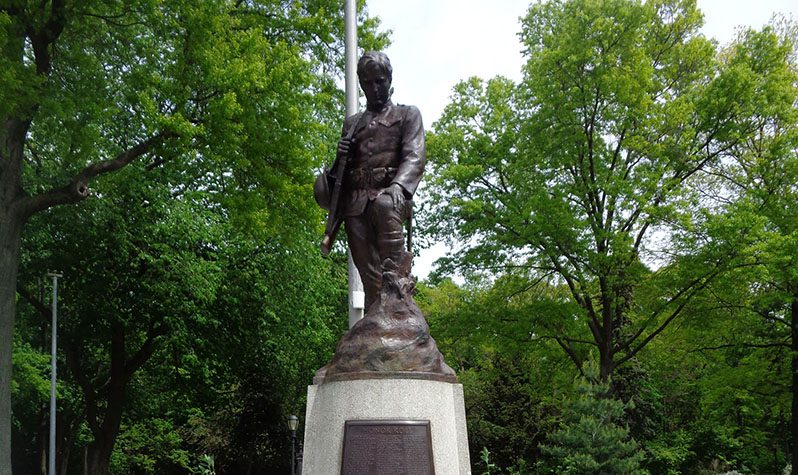
This is another monument dedicated to the heroes of World War I. Since 1925, it has honored approximately 140 fallen residents from Woodhaven and Richmond Hill. The sculpture represents the average “doughboy”—the term used for an American infantryman during WWI. The nickname most likely originated from a popular biscuit or cookie consumed by the troops. It was first used by the British in the 18th and 19th centuries to describe soldiers and sailors.
The American infantrymen involved in World War I combat were very young—on average, under 25 years old. Following the victory of the Allies, numerous communities commissioned statues in honor of their heroes. Nine of these were installed in New York City parks, including the Richmond Hill War Memorial. In total, over 500,000 New York State residents served—12.5% of the entire U.S. Army.
The Richmond Hill War Memorial is a sculpture of a mournful soldier with a bowed head, rifle, and helmet. Some speculate that the prototype for the soldier was actor and director Francis X. Bushman, due to their physical similarity. The granite pedestal is adorned with decorative bronze elements, such as waves, garlands, acanthus leaves, and a ram’s head. A plaque listing the names of the soldiers is placed at the statue’s base.
Soldiers and Sailors Monument
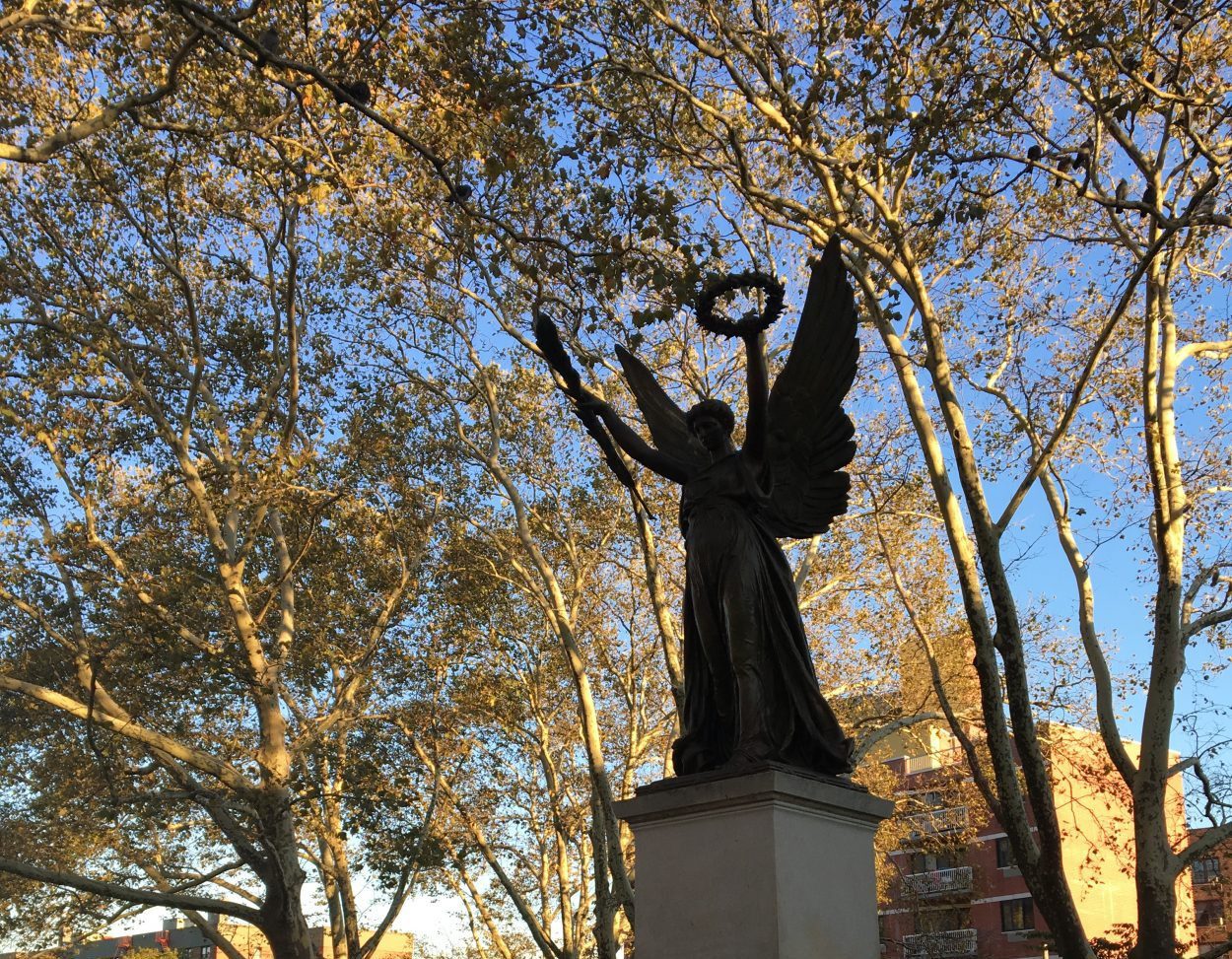
Queens has the fewest monuments dedicated to the Civil War of all New York City boroughs. However, a few memorials can still be found that recall the bravery shown by warriors during the nation’s great divide. One of them is the Soldiers and Sailors Monument. Since 1896, it has honored the memory of soldiers and sailors from Queens who died in the war between the American states.
The Civil War is considered the bloodiest conflict in U.S. history. It lasted from April 1861 to May 1865 between the Confederacy (the Southern states) and the Union (the Northern states). The Confederacy rebelled against the Union for economic and political reasons, primarily centered on slavery. The conflict ended with the defeat of the Confederates. Although the war did not solve all problems, some contradictions were overcome. Notably, the 13th Amendment to the U.S. Constitution, which prohibited slavery, took effect on December 18, 1865. Furthermore, the country saw conditions created for accelerated industrial and agricultural development, the settlement of Western lands, and the strengthening of the domestic market.
Approximately 658,000 people were killed and another 420,000 were wounded during the fighting. Roughly 370,000 New Yorkers fought for the Union—one out of every five men in the state! Queens residents fought bravely alongside other Northerners to preserve the Union.
The Soldiers and Sailors Monument is made of bronze and granite. The bronze figure of an angel displays the symbols of victory (a laurel wreath in the left hand) and peace (a palm frond in the right hand). The years of the Civil War are carved into the lower part of the statue.