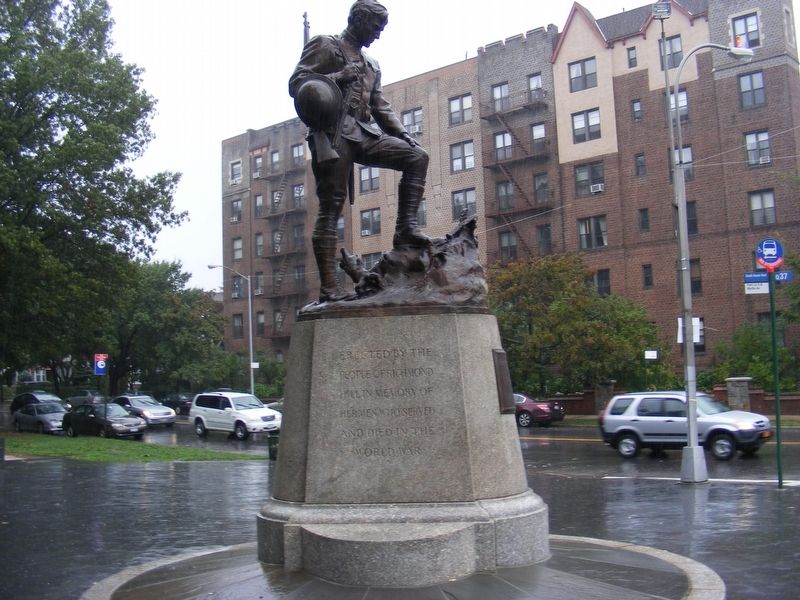

More than 116,000 American servicemen died during World War I, one of the bloodiest conflicts in human history. A monument towering over the Richmond Hill neighborhood of Queens honors the fallen residents of local communities who contributed to the victory of the Allies. The memorial was dedicated on November 10, 1925. Read on for more details about this symbol of courage and sacrifice at queensyes.com.
Dedicated to the Young Infantrymen
The statue depicts the average infantryman, famously known as a “doughboy.” The term likely relates to the name of a biscuit popular with the troops. During World War I, “doughboy” was the popular nickname for an American infantry soldier. The British first used the term in the late 18th and early 19th centuries to describe soldiers and sailors. In the U.S., the nickname appeared during the Mexican-American War (1846–1848) but gained widespread popularity between 1914 and 1918.
Americans participated in the final stages of World War I between 1917 and 1918. After the war concluded, numerous communities commissioned statues of young men to honor their local heroes. One of nine such statues installed in New York City parks was commissioned for the Richmond Hill War Memorial. Interestingly, the infantrymen involved in the combat were very young, with an average age of 25. At the memorial’s dedication ceremony in 1925, Queens Parks Commissioner Albert C. Benninger accepted the monument on behalf of the city, and the sculpture was unveiled by Mrs. Mathilde Burling, President of the Richmond Hill Mothers’ Association.
The memorial commemorates nearly 140 residents of Woodhaven and Richmond Hill who died for peace. The U.S. maintained neutrality until April 6, 1917, when it officially joined the war. American forces actively participated in battles on the Western Front, making a significant contribution during the final and decisive Allied offensive. New York State suffered the greatest loss among all states, with 13,956 residents dying in combat. In total, official reports state that over 500,000 New Yorkers joined the armed forces during the war—12.5% of all individuals who served in the United States Army.
Who Created It?
The statue’s creator is Italian-American artist Joseph Pollia, a prolific sculptor of monuments and war memorials. For the Richmond Hill War Memorial, he chose the concept of a grieving soldier with a bowed head, a rifle, and a helmet. According to one account, the soldier’s prototype was actor and director Francis X. Bushman. Some observers note a physical resemblance between the silent film star and the soldier on the monument.
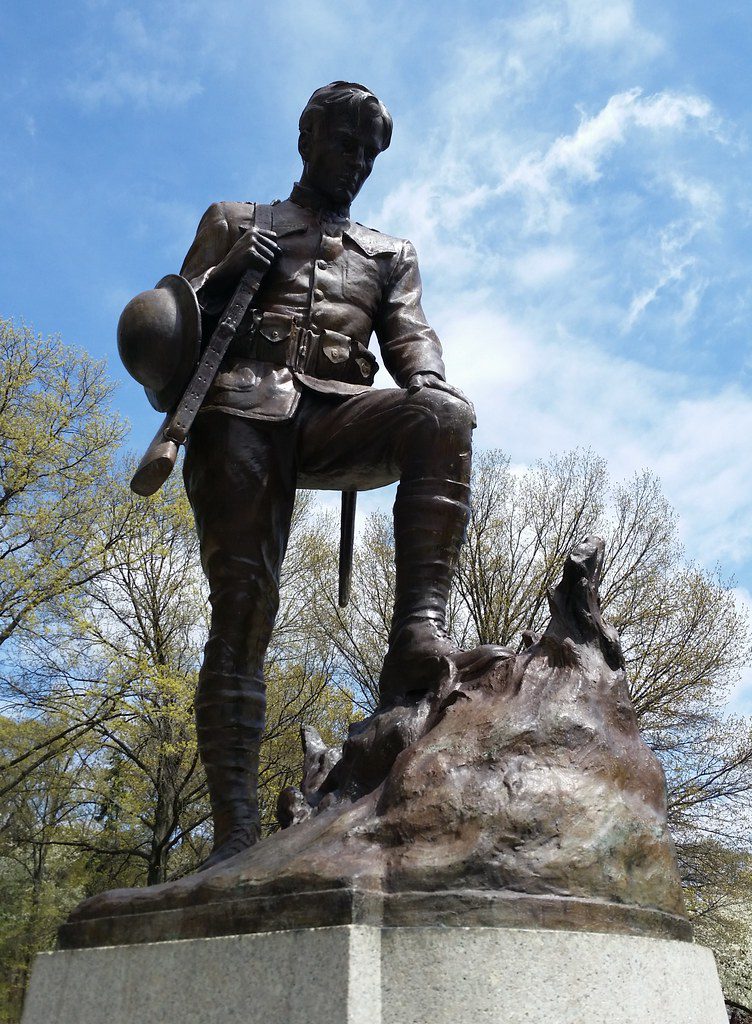
The memorial itself was designed by American architect William van Alen, best known for designing New York’s iconic Chrysler Building. The granite pedestal is adorned with decorative bronze elements such as waves, garlands, acanthus leaves, and a ram’s head. A plaque bearing the names of the soldiers is placed at the base of the statue.
Incidentally, Richmond Hill is a neighborhood known for its tree-lined streets, Victorian-style homes, and commercial buildings. It is home to many religious institutions, including Jamaican and Indian temples. One of the main attractions of Richmond Hill is Forest Park, which covers over 500 acres of green space with hiking trails, a golf course, and recreation facilities. The multi-ethnic district blends cultures from around the world, making it a diverse and vibrant community. Its name comes from the Richmond Hill in London, England.