
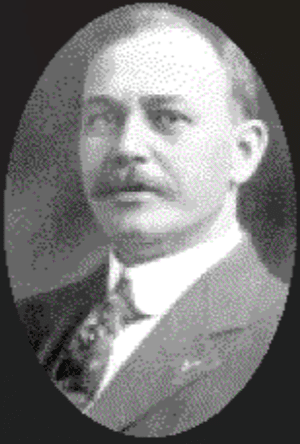
Joseph Bermel served as president of Queens from 1906 to 1908. After a two-year term, he resigned due to abuse of office. His tarnished reputation and fear of prosecution forced him to flee the country. Read more about the odious borough leader on queensyes.com.
Political career
Joseph Bermel was born on April 8, 1860 in Brooklyn. In the early 1880s, he moved to Queens, where he established a stonemasonry business, including the production of monuments for cemeteries. After Bermel became interested in politics in the 1890s, he became a city supervisor in Newtown (present-day Elmhurst).
As a result of the consolidation of New York City in 1898, Queens became one of its 5 boroughs. At that time, Bermel continued to fulfill his duties but at the borough level. When Democrat Joseph Cassidy took over as Queens’ president, Bermel began working in his office as a public works commissioner.
During his tenure as president, Cassidy bought a steam yacht, a car, several trotters, a cattle farm in California, a house in Long Island City and a country house in Far Rockaway. He was charged with 47 counts of financial fraud but prosecutors dropped all charges.
In 1905, Cassidy ran for president for the third time. Unexpectedly for him, Bermel also ran for office. He won the election, beating his former mentor. The politician promised voters to fight bribery in any form.
However, promises remained promises. Like Cassidy, Bermel was quickly suspected of abusing his power. Perhaps Bermel’s main achievement in office was the purchase of land to create Kissena Park. Located in the Flushing neighborhood, along an underground river, Kissena Park is a great place to relax in the lap of nature. Subsequently, it turned out that the city had allocated a much higher amount than the fair market value. The fact is that those plots belonged to Bermel’s friends.
Accusation and escape
In April 1908, New York Governor Charles Evans Hughes instructed the commissioner to investigate and advise him on whether or not to remove Bermel from office. Even before he testified, Bermel resigned. Rumors quickly spread through the city that he was planning to flee the country on an ocean liner. Therefore, the district prosecutor served the former president with a subpoena, requiring him to testify.
He did testify in the morning, after which he was released for a while, hoping for the politician’s honesty: he promised to return at 2 p.m. the same day. An hour after Bermel left the courtroom, he boarded a ship and headed for Rome. In August of the same year, 3 months after his escape, Bermel returned to New York. The Queens District Attorney dropped all charges against him.
The former president died in 1921 at the age of 61 in Czechoslovakia. He was there on business and at the same time visiting his son-in-law, Captain Frank Jedlika, assistant Military Attache to the American Mission to Czechoslovakia.
Bermel was succeeded as president by Lawrence Gresser. The Bavarian native worked as a shoemaker before emigrating to the United States. In 1898, he entered the civil service, including serving as a commissioner of public works under Bermel. Gresser, like his predecessors, abused his position during his administration of Queens (1908-1911).
As for Cassidy, in 1912 he tried to sell William Willett a nomination to the New York Supreme Court for $30,000. For this, he was sentenced to a year in prison. After his parole, Cassidy tried to return to politics. However, he was not allowed to do so because of his gambling.